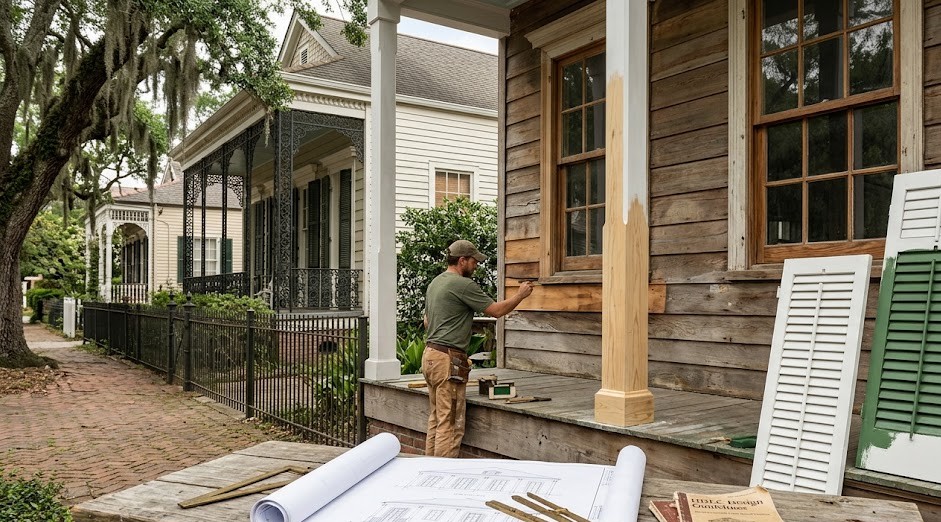
New Orleans has more than 14,000 historic resources recognized by the National Register of Historic Places. That is not a background statistic. For homeowners in neighborhoods like the Garden District, Irish Channel, Mid City, Uptown, Holy Cross, Marigny, and dozens of other areas, it means that a simple exterior renovation comes with rules that most cities do not have.
The architecture is a major reason people buy in these neighborhoods. Creole cottages, shotgun doubles, camelback houses, Victorian galleries, Craftsman bungalows. These homes have character that new construction cannot replicate. But living in one means accepting a set of renovation restrictions that many homeowners do not fully understand until they are already mid-project.
This is a breakdown of the rules, the approval process, and the mistakes that cost homeowners time and money when remodeling a historic property in New Orleans.
Two Commissions, Two Sets of Rules
New Orleans has two separate commissions that oversee historic property. Which one applies to you depends entirely on where your home is located.
The Historic District Landmarks Commission (HDLC) regulates 14 historic districts across the city. These include Uptown, Garden District, Irish Channel, Lower Garden District, Mid City, Holy Cross, Algiers Point, and others.
The Vieux Carre Commission (VCC) oversees the French Quarter exclusively. The French Quarter has its own separate design guidelines and approval process.
If your property is in an HDLC district, exterior work visible from the public right of way requires a Certificate of Appropriateness before you can apply for a building permit. If your property is in the French Quarter, the VCC has a similar but distinct approval process with its own standards.
The interior of your home is your domain. Neither commission has authority over interior renovations. You can remodel your kitchen, update your bathroom, or reconfigure interior rooms without commission approval. The restrictions apply to anything visible from the street.
Full Control vs. Partial Control Districts
Not all HDLC districts have the same level of oversight. The commission divides its jurisdictions into two categories, and the distinction matters.
Full control districts require HDLC approval for new construction and all exterior work visible from the right of way. That includes windows, doors, siding, roofing, porches, fences, paint colors, shutters, and even mechanical equipment placement if it can be seen from the street.
Partial control districts limit HDLC oversight primarily to demolition requests and certain structural or building requirements. In a partial control district, you typically have more flexibility with exterior modifications, though demolition thresholds still apply.
The rules vary by neighborhood. What flies in one district may trigger a full commission hearing in another. Before you start planning exterior work, you need to know whether your property is in a full or partial control area and what specific guidelines apply.
The Certificate of Appropriateness Process
The Certificate of Appropriateness (CofA) is the approval document you must obtain from the HDLC or VCC before applying for a building permit for exterior work. Here is how it works.
Step 1: Determine your property’s historic rating. Contact the HDLC to find out how your property is classified. The rating affects what type of work requires approval and what level of review applies.
Step 2: Review the HDLC Design Guidelines. The commission published an updated, illustrated set of design guidelines that cover everything from siding and roofing to windows, porches, fences, and new construction. These are available for free on the city’s website at nola.gov/hdlc. The guidelines are organized by topic and architectural element, making it relatively easy to find what applies to your project.
Step 3: Submit your application. Working with your contractor or architect, you submit a CofA application through the city’s One Stop App. The application needs to include the scope of work, material specifications, drawings or renderings showing proposed changes, and photographs of the existing conditions.
Step 4: Review and approval. Your application is reviewed by HDLC staff. Depending on the scope and complexity, it may be approved at the staff level, reviewed by the Architectural Review Committee (ARC), or require a full commission hearing. Simple projects that closely follow the design guidelines often get staff-level approval. Projects that propose changes outside the guidelines need ARC review or a commission hearing.
The timeline varies. Staff level approvals can be relatively quick. Commission hearings are scheduled monthly, and if revisions are needed, each cycle adds more time. A realistic planning window for HDLC approval is two to six weeks for straightforward projects and several months for complex ones.
What the Guidelines Actually Restrict
The HDLC design guidelines are more specific than most homeowners expect. Here are the areas that generate the most surprises.
Windows. In full control districts, replacing historic wood windows with vinyl or aluminum windows is generally not approved. The guidelines favor repair of original windows or replacement with new wood windows that match the original profile, muntin pattern, and proportions. If the original windows are beyond repair, you may need to provide documentation proving that before a replacement is approved.
Siding. The guidelines address siding material, profile, and installation method. In many cases, fiber cement siding (like Hardie board) may be approved as an alternative to wood, depending on the district and the property’s rating. Vinyl siding is almost never approved for properties with a significant historic rating.
Roofing. The material, color, and profile of roofing are reviewed. Standing seam metal roofs and slate are common in New Orleans historic homes. Architectural shingles may be approved in some districts, but the specifics depend on the property and the neighborhood’s character.
Porches and galleries. New Orleans is famous for its porches. Modifying or enclosing a porch, changing column styles, altering railings, or adding screening all require HDLC review in full control districts. The guidelines are particular about maintaining the proportions and character of the original porch design.
Fences and gates. Height, material, transparency, and placement of fences are all regulated. A solid six-foot fence in the front yard is unlikely to be approved in most historic districts where traditional wrought iron or picket fences are the norm.
Paint colors. In some full control districts, exterior paint colors require HDLC approval. This does not mean you cannot paint your home a color you like. It means the commission reviews your chosen palette for appropriateness within the neighborhood’s visual character.
Mechanical equipment. HVAC condensers, generators, and other mechanical equipment visible from the street must be screened or placed where they cannot be seen. The guidelines specify acceptable screening methods and placement locations.
The Stop Work Order Risk
Starting exterior work without a Certificate of Appropriateness is one of the most expensive mistakes a homeowner can make in a historic district.
The HDLC actively monitors construction activity in its districts. If work is started without approval, the city issues a Stop Work Order. All construction stops immediately. The order stays in place until the homeowner applies for and receives a CofA, which can take weeks or months depending on the commission’s calendar and whether the unapproved work needs to be reversed.
During that time, your contractor’s crew is not on site. Your project timeline is frozen. And depending on the nature of the violation, you may be required to undo work that was already completed and redo it in compliance with the guidelines. That means paying twice for the same scope of work.
A general contractor experienced in New Orleans historic renovations will build the CofA process into the project timeline from the start, so you never run into this problem.
The 50% Permit Surcharge
There is a financial detail that catches homeowners off guard. Work in HDLC or VCC jurisdictions carries a 50 percent surcharge on building permits, reviews, and demolition fees. This is on top of the standard permit costs.
For a major home remodel, the surcharge can add hundreds or thousands of dollars to your permitting costs depending on the project’s valuation. It needs to be in your budget from day one, not discovered after the fact.
Tax Credits Can Offset the Extra Costs
Here is the upside that many homeowners miss. Louisiana has one of the strongest historic rehabilitation tax credit programs in the country. In fact, Louisiana ranked second nationally for completed federal historic tax credit projects in 2025, with 94 project certifications that year alone.
The programs work like this:
Federal Historic Tax Credit: A 20 percent credit on qualified rehabilitation expenses for income-producing properties listed on the National Register of Historic Places. The property must be income-producing (rental, commercial), so this does not directly apply to owner-occupied homes. But for homeowners who rent part of their property or who are renovating a property for rental income, the credit can be substantial.
Louisiana State Historic Tax Credit: A 25 percent credit on eligible rehabilitation costs for qualifying properties (35 percent for properties in rural areas). Like the federal credit, this currently applies to income-producing properties. The state program runs through December 2028 and has been capped at $85 million in annual reservations as of January 2025.
Both credits can be stacked, meaning a qualifying project could receive a combined 45 percent credit on eligible expenses. The credits are also transferable, so even if the owner does not have the tax liability to use them directly, they can be sold.
For owner-occupied homes that do not qualify for the tax credit programs, the Preservation Resource Center of New Orleans is a strong resource. They offer guidance on navigating HDLC requirements, finding preservation-focused contractors, and understanding what incentives or programs may be available.
Common Mistakes Homeowners Make
After 20 years of remodeling homes across the New Orleans area, these are the historic renovation mistakes we see most often.
Assuming interior work is all that matters. Many buyers fall in love with a historic home and plan a full interior remodel without realizing that the front porch repair, new windows, and roof replacement all need separate HDLC approval.
Hiring a contractor who has never worked in a historic district. The HDLC process has specific documentation requirements, material standards, and approval timelines. A contractor who is not familiar with the process will cause delays, submit incomplete applications, and potentially trigger a Stop Work Order.
Not budgeting for the permit surcharge and extended timeline. Historic district renovations cost more in permitting fees and take longer to get approved. Both of those facts need to be reflected in your project budget and schedule.
Choosing materials before checking the guidelines. Vinyl windows might be half the price of wood windows, but if the HDLC rejects them, you have wasted time and possibly money on materials you cannot use.
Skipping the design guidelines entirely. The HDLC guidelines are free, publicly available, and illustrated with diagrams. Reading them before you start planning saves more problems than any other single step you can take.
Working With (Not Against) the Process
The HDLC process is not designed to prevent renovation. It is designed to make sure renovations respect the architectural character that makes these neighborhoods valuable in the first place.
Homeowners who approach the process with the right information, the right contractor, and realistic expectations tend to move through it smoothly. Those who try to shortcut it, ignore it, or fight it end up spending more time and money than they planned.
The best approach is simple. Read the guidelines early. Build the CofA timeline into your project schedule. Choose a contractor who has worked in New Orleans historic districts before. And ask questions before you commit to materials or designs that may not be approved.
If you own a historic home in New Orleans and you are planning a remodel, contact Continental Construction for a free consultation. We have been renovating homes across the city’s historic districts for over two decades, and we know how to keep your project on track from the first application to the final walkthrough.